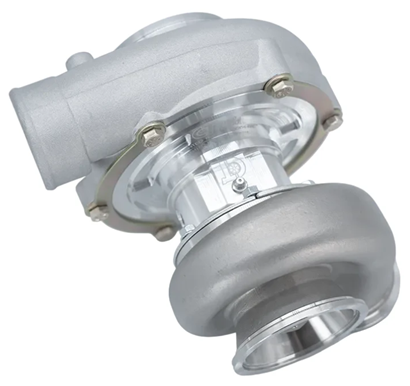
Oil‑Less Turbochargers: The Next Evolution in Boost Technology
Turbocharger technology has come a long way since the early days of simple journal‑bearing units fed by engine oil. Today, a new innovation is reshaping what’s possible in forced induction: oil‑less turbochargers. These systems eliminate the need for engine‑supplied lubrication, opening the door to cleaner installs, more flexible mounting options, and reduced maintenance- all while delivering the high‑RPM performance enthusiasts expect!
But how do they work, and are they truly reliable? Let’s break it down:
What Is an Oil‑Less Turbocharger?
Oil‑less turbochargers use a self‑contained bearing system that does not rely on engine oil for lubrication. Instead, manufacturers like Comp Turbo use advanced Triplex Ceramic ball‑bearing assemblies engineered to operate with minimal friction and without the need for oil feed or return lines. These systems are typically water‑cooled, using the engine’s coolant circuit to manage bearing temperatures. This keeps the turbo thermally stable even under high load. 
How Oil‑Less Turbos Work
Traditional turbos depend on a constant supply of clean, pressurized oil to lubricate the bearings. Oil‑less turbos replace this with:
- Ceramic ball bearings with extremely low friction
- A sealed bearing cartridge pre‑lubricated for long service life
- Water‑cooling passages to regulate temperature
- A Zerk Grease fitting on some models for periodic service without disassembly

This design allows the turbo to spin at extreme speeds, often over 100,000 RPM, without relying on the engine’s lubrication system.
Key Advantages of Oil‑Less Turbochargers
1. No Oil Lines= No Leaks, No Smoke
Oil‑less turbos eliminate the most common installation headaches:
- No oil feed line routing
- No gravity‑dependent oil return
- No risk of oil leaks causing smoking issues
This is especially valuable in tight engine bays or custom builds where oil routing is difficult.
2. Mount in Any Orientation
Because there’s no oil return that must flow downhill, oil‑less turbos can be mounted:
- Vertically
- Horizontally
- Upside‑down
- At extreme angles
This gives fabricators and kit designers far more freedom.

3. Cleaner, More Reliable Operation
Oil contamination from engine wear is a major cause of turbo failure. Oil‑less systems avoid:
- Dirty oil
- Oil starvation
- Coking in the center housing / oil galley
This can significantly improve long‑term reliability.
4. Reduced Maintenance
With no oil to change, maintenance is minimal. Most units include a simple grease‑service port for long‑term upkeep.
Are Oil‑Less Turbos Reliable?
According to industry sources, oil‑less turbochargers have proven to be highly reliable when properly cooled and installed. Comp Turbo’s oil‑less units use the same internal components as their oil‑lubricated Triplex Ceramic systems, with the exception of the bearing carrier design.
Real‑world reviews and long‑term testing show strong durability, even under high‑boost, high‑heat conditions.
Ideal Applications for Oil‑Less Turbochargers
Oil‑less turbos shine in:
- Custom turbo kits with limited space
- Rear‑mount turbo systems
- Marine applications
- Motorsports builds where reliability and serviceability matter
- Fabrication‑heavy projects where mounting flexibility is key
For retailers like TurboKits.com, oil‑less technology opens the door to cleaner, more modular system designs with fewer failure points.
Are Oil‑Less Turbos Right for You?
If you’re building a turbo system where:
- Oil routing is difficult
- You want maximum reliability
- You prefer a cleaner, simpler installation
- You want to avoid oil‑related smoking issues
…then an oil‑less turbocharger may be the perfect solution!
They’re not necessarily for every build as high‑end ceramic bearing systems come at a premium price, but for many enthusiasts and fabricators, the benefits far outweigh the cost.
Oil‑less turbochargers represent one of the most exciting advancements in modern forced‑induction technology. By eliminating the need for engine oil, they simplify installation, reduce maintenance, and offer unmatched flexibility in turbo placement. As the technology continues to mature, expect to see oil‑less systems become increasingly common in performance builds across the industry.